What is Action Research?
Action Research aims to deepen a teacher’s understanding of their own teaching practice and its gives teachers the opportunity to investigate their teaching practices within their own classrooms. The research centres on an issue of concern, a challenge or ‘problem’ that the teacher has identified with their own teaching. Teachers, together with their students, are the subject of their own research.
Action research involves systematically investigating that issue and moves through these steps:

The Action Research in ELICOS Program is run in partnership by English Australia and Cambridge.
English Australia, in partnership with Cambridge, has been running the Action Research in ELICOS Program since 2010. During the Program, teachers are guided through implementing an action research project in their own classroom. They participate in three workshops, online discussions, and report writing over 6 months, supported by Action Research expert Professor Anne Burns and English Australia. At the end of the Program, teachers present the outcomes of their research at the English Australia Conference and publish their research reports in the Cambridge Research Notes journal.
Anne Burns, Professor of TESOL at the School of Education, University of New South Wales and Professor in Language Education, School of Languages and Social Sciences, Aston University, Birmingham, UK is the key academic reference person for the program who supports the teachers. Anne is recognised internationally as an expert in action research and has had considerable experience in planning, implementing and reporting on action research programs around the world. She has published widely on the topic.
Each year, the research reports of Program participants are published in the Cambridge Research Notes publication and teachers are supported to prepare their research reports for publication. The following publication editions contain recent reports from the Action Research in ELICOS Program: Research Notes 87 (2023 Program), Research Notes 85 (2022 Program), Research Notes 83 (2021 Program), Research Notes 81 (2020 Program), Research Notes 79 (2019 Program), Research Notes 74 (2018 Program), Research Notes 69 (2017 Program).

Directors of Studies report that having a teacher involved in the program strengthened teachers’ concepts of teaching practice and professional development; increased interest in and engagement with teacher-initiated research; and developed a sense of professionalism related to awareness of a wider world within and outside the organisation.
All past participants in the program report they have gained considerably from the opportunity to explore an area of interest to them, to develop their professionalism and also to engage with other teachers who are passionate about teaching. Here are just a few comments:
‘It was a profound experience both professionally and personally. It’s taught me a lot about myself as a teacher and has given me a deeper insight into the way students learn.’
‘Great professional development and a springboard for further opportunities.’
‘It’s a wonderful opportunity to take a look at research in a practical way. It is also good to meet other practitioners and to hear about other centres.’
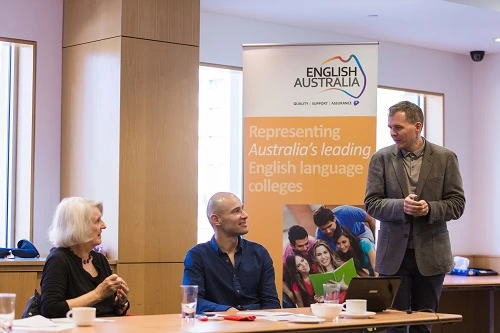
2017 Action Research Program participants
2026 Research theme
The research theme for the 2026 Action Research in ELICOS program is:
‘Shaping inclusive learning materials for diverse cohorts in a digital/GenAI age’
In an increasingly digital learning environment, the ways English language teachers select, adapt and create learning materials are evolving rapidly. The term ‘materials’ refers to a wide range of resources used for learning purposes, including print-based texts, teacher-created resources, audio, video, multimedia and LMS-based content, mobile technologies, and AI-enabled tools. There is a growing impetus to ensure these materials are inclusive, accessible and responsive to the diverse needs of English language students.
The research theme encourages educators to explore what inclusive materials look like for today’s diverse ELICOS cohorts—students who vary in linguistic and cultural backgrounds, educational experiences, English proficiency levels, digital literacies, learning preferences, and goals for studying in Australia. In this context, inclusivity also encompasses the needs of neurodiverse and LGBTQI+ learners, recognising that materials must support a wide spectrum of abilities, perspectives and ways of engaging with language learning. Educators are invited to consider how thoughtful design, adaptation and the integration of digital and/or AI-enabled tools can better support all learners.
This year’s research theme is intentionally broad, and we invite researchers to investigate any aspect of it through Action Research. Examples of possible areas include, but are not limited to:
Eligibility for Program participation
The Program is open to educators who meet the following criteria:
Funding
The Program is generously sponsored by Cambridge, and all training is delivered by English Australia and Professor Anne Burns.
Funding and participant contributions are as follows:
Workshop 1 – Two Days:
Workshop 2 – Sydney, 22 May 2026, 10:00am – 4:00pm
Workshop 3 & English Australia Conference – Melbourne:
One Candidate Funded Place Available in 2026
In 2026, English Australia will offer an additional candidate funded place in the Program. All expressions of interest will be assessed on merit, with five initial funded offers made. Once these participants have confirmed their places, the author(s) of the next highest-ranked expression of interest will be contacted and offered the candidate funded place.
For fully funded places, participants will need to cover the following expenses:
Workshop 1 – Two Days:
Workshop 2 – Sydney, 22 May 2026, 10:00am – 4:00pm
Workshop 3 & English Australia Conference – Melbourne:
Key responsibilities of Program participants
Successful participation requires commitment from both teachers and their employers. Participants are expected to:
Teachers participating in this Program make a considerable commitment of time. Employers must support participants by releasing them from teaching and other duties for a minimum of six days during the Program.
2025 Program Timeframe and Commitments
English Australia held an Information Webinar about joining the 2025 Program on Monday 25 November at 3.30-4.30pm (AEDT). You can watch the recording of that webinar and view the webinar slides.
Webinar by Anne Burns, Program Leader, entitled ‘What is Action Research?’
Questions: Contact Sophie, General manager – Operations at English Australia, sophieokeefe@englishaustralia.com.au, or phone 0426 814 577 for more information.
In 2013 English Australia won an IEAA Award for Best Practice/Innovation in International Education for the Action Research Program.